

Rest at MD+2 promotes player freshness across the microcycle in professional soccer
Çiçek I, Türkeri C, Gürol B, Buchheit M. Rest at MD+2 promotes player freshness across the microcycle in professional soccer. Sport Performance & Science Reports. 2026; May; 295; v1.
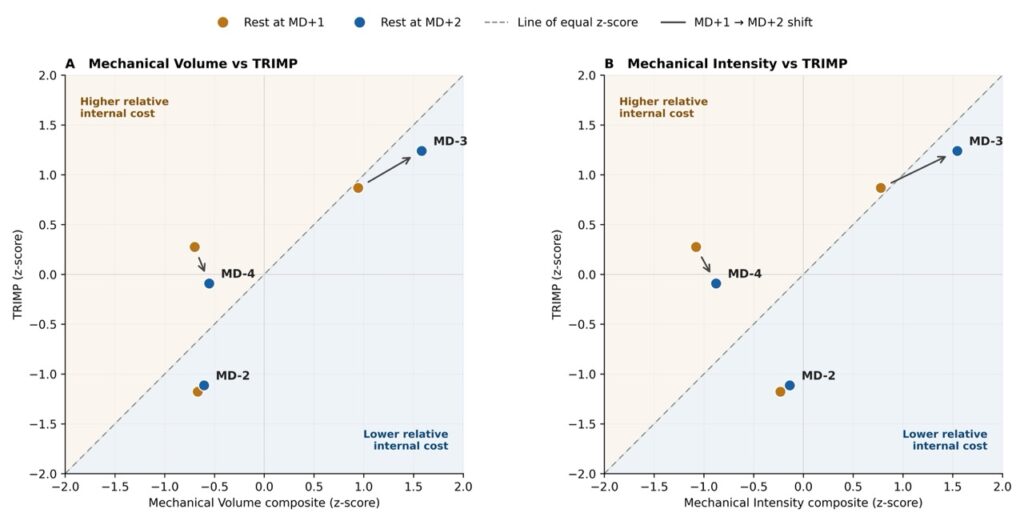
Figure 2. Integrated external-to-internal load relationship using z-scored composites against z-scored TRIMP. Panel A: Mechanical Volume vs TRIMP. Panel B: Mechanical Intensity vs TRIMP. Each point is one training day under one rest-day strategy. The dashed line is the line of equal z-score between the two axes and serves as a visual reference for reading the points: above it, cardiovascular cost is higher relative to mechanical output than the dataset average; below it, lower. Arrows connect Rest at MD+1 to Rest at MD+2 for each training day.
📅⚽ Most clubs rest at MD+1. The data keeps suggesting that’s the wrong call.
Resting at MD+2 is not a new idea. Raymond Verheijen has been making this case since at least 2014. What was missing was the training-load data to back it up. This paper provides exactly that.
Across 12 weeks in a Turkish professional club, the same squad operated under both strategies. The findings are directionally consistent with our injury surveillance data from 56 team-seasons across 18 elite European clubs (https://martin-buchheit.net/2022/11/14/3303/).
The key insight is that rest day placement changes the overall loading strategy and patterns across the whole week — and those differences leave a visible signature in the external-to-internal load relationship.
On MD-4, overall mechanical load was similar between conditions. But under MD+2 rest, players produced that same work at lower cardiovascular cost. A freshness signature: the physiological state in which players arrived shaped how their body responded to the same session.
On MD-3, the heaviest day of the week, mechanical load was substantially higher under MD+2 rest (42% vs 36% of match values), with cardiovascular cost scaling broadly proportionally. A tolerance signature: the weekly loading pattern that follows MD+2 rest allows more work to be delivered and absorbed on the days that matter most.
MD-2 was equivalent under both strategies.
The mechanism behind all of this is straightforward. MD+2 rest means MD+1 is a working day: starters get proper supervised recovery, substitutes get a structured compensation session. MD+1 rest means neither group gets what they need.
One honest caveat: sequential design, one club, exploratory rather than confirmatory. But the direction is consistent across every dataset we have looked at.
Where you put the rest day shapes the physiological state players bring to every session that follows. Still, in 2026, most clubs have not made the switch.
👏 Great work with İsmail Çiçek (https://www.linkedin.com/in/dr-ismail-çiçek-aa78a9252), Cenab Türkeri (https://www.linkedin.com/in/cenab-türkeri-17bb66334), and Barış Gürol (https://www.linkedin.com/in/barış-gürol-753205410).