
Data everywhere, now timing matters: a day-by-day implementation of the quadrant-based monitoring framework in elite football
Hader K, Buchheit M. Data everywhere, now timing matters: a day-by-day implementation of the quadrant-based monitoring framework in elite football. Sport Performance & Science Reports. 2026 Jul;#307:v1.
Full Text here
Everyone has a monitoring system. Almost no one has a monitoring plan.
Since we published the quadrant model with Karim Hader in 2025, I have presented it around the world. Roughly 15 talks, plus webinars, plus a full HIIT Science course built on it. The same question came back every single time: fine, but what do I actually do on D+1?
Fair question. The model sorted the tools. It did not tell you when to use them, or what to do with the number once it lands.
That is step 2. It took us a while. It was worth the wait.
What is in it:
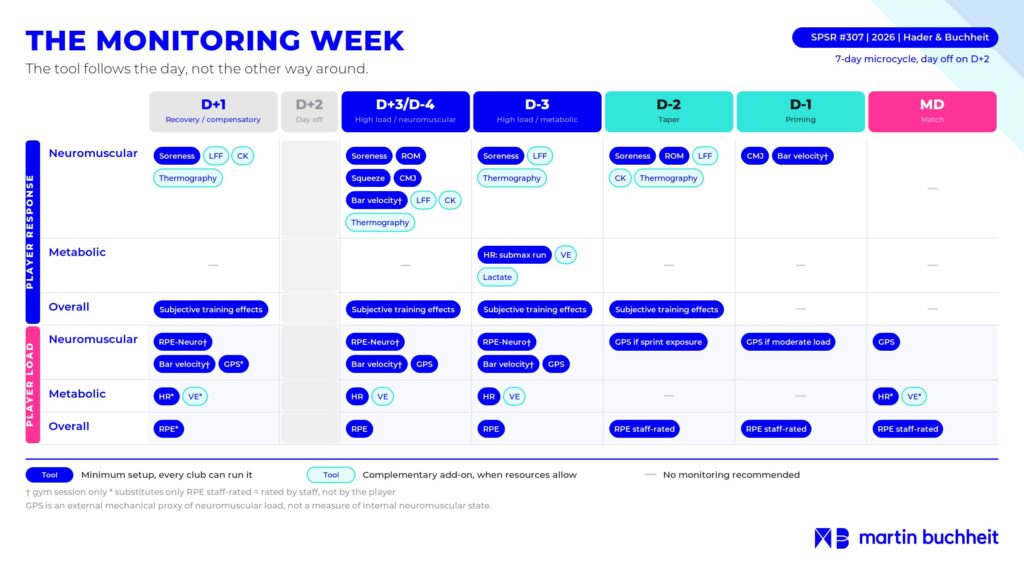
📅 A day by day plan across the microcycle, D+1 to MD, for a day off on D+2 and on D+1
🧰 The minimum setup every club can run, separated from the optimal add ons
🔁 The tool follows the day. Passive measures only on recovery days. CMJ and bar velocity on D+3/D-4. Submaximal HR run on D-3
📏 Thresholds to know if a change is real before you act on it
🧭 A 2×2 matrix, read twice: once neuromuscular, once metabolic
The part I care about most is the clock. The two systems do not run on the same one. A neuromuscular signal can change today’s session. A metabolic signal almost never does, it tells you what to add next week. Collapse both into one “load” score and one generic action (“reduce load”) and you have thrown away the only information worth having.
Honest caveat: this is a framework, not a trial. We have not shown prospectively that following it improves outcomes, and the thresholds in Table 3 are working defaults to recalculate with your own data.
It should give you more training, not less. The measure of a good monitoring system is not how often it flags a player for rest, but how rarely it needs to.
Hader K, Buchheit M. Data everywhere, now timing matters: a day-by-day implementation of the quadrant-based monitoring framework in elite football. Sport Performance & Science Reports. 2026 Jul;#307:v1.
#FootballScience #AthleteMonitoring #TrainingLoad #SportScience #Microcycle