
From Rule of Thumb to Mechanistic Formula: An AI-Assisted Model for Individualizing Shuttle Run Distance in HIIT
Buchheit M, Lopez Sagarra A, Ogden A and Houben C. From Rule of Thumb to Mechanistic Formula: An AI-Assisted Model for Individualizing the Cost of Changes of Direction in Shuttle Run Prescription. Sport Perf Sci Reports, 294, May 2026, v1.
Full link here
Download
- Old spreadsheet ENG / Spanish / French (0.7s rule, for reference)
- New spreadsheet (mechanistic model)
- A companion web tool
- More tools from the 30-15IFT webpage
A new mechanistic model for adjusting shuttle run distance during high-intensity intermittent training, developed as part of the Sport Science 3.0 series using AI (Claude, Anthropic) as a collaborative reasoning partner.
The problem
For nearly 20 years, we have adjusted shuttle distances during HIIT using a simple rule: subtract 0.7 seconds per change of direction from the available running time (Buchheit, 2008), later refined to a 2-3% distance reduction per COD (Buchheit & Laursen, 2019). While practically useful, this approach does not scale with running speed, ignores individual differences in acceleration/deceleration capacity, and cannot distinguish between shuttle lengths. When training shuttle lengths differ from the 40m used in the 30-15IFT, the overprescription grows with each additional COD: at 40m (1-2 CODs per interval), the error is small; at 20m (3 CODs), it accumulates; at 10m (6+ CODs), it can exceed 15 percentage points.
What we did
Starting from first-principles physics of the deceleration-reacceleration cycle at each 180-degree turn, we derived a formula that replaces the empirical rule:
d_adjusted = v x (t_work – n_cod x t_cod)
where t_cod = v / A0 is the individualized, speed-dependent time lost per COD. The model replaces the fixed 0.7s with a value derived from each player’s acceleration and deceleration capacity (A0, default 7.5 m/s²). A key finding: the original 0.7s was not arbitrary. At ~19 km/h with A0 = 7.5, the model produces t_cod = 0.72s, explaining why the old rule worked for 20 years. But it only works for “average” players at moderate speeds.
The model individualizes through three mechanisms: (1) A0-based, where players with lower braking capacity get larger corrections (the difference between A0 = 7.5 and A0 = 5.0 shifts distance by ~8 percentage points), (2) speed-based, where faster players lose more time per turn since t_cod scales with v, and (3) shuttle-length-based, where shorter shuttles produce more CODs and larger total corrections. The model works with either MAS/MSS (Pathway A, recommended) or vIFT (Pathway B) as the reference speed.
The spreadsheet is dead. Long live the spreadsheet.
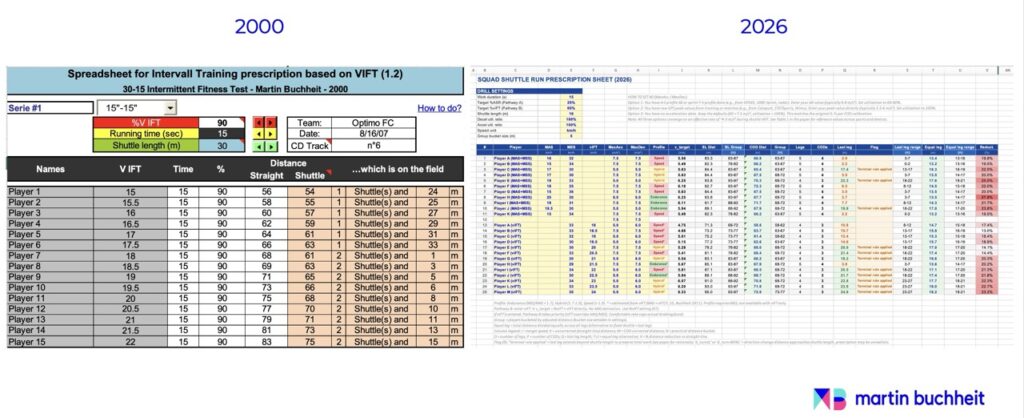
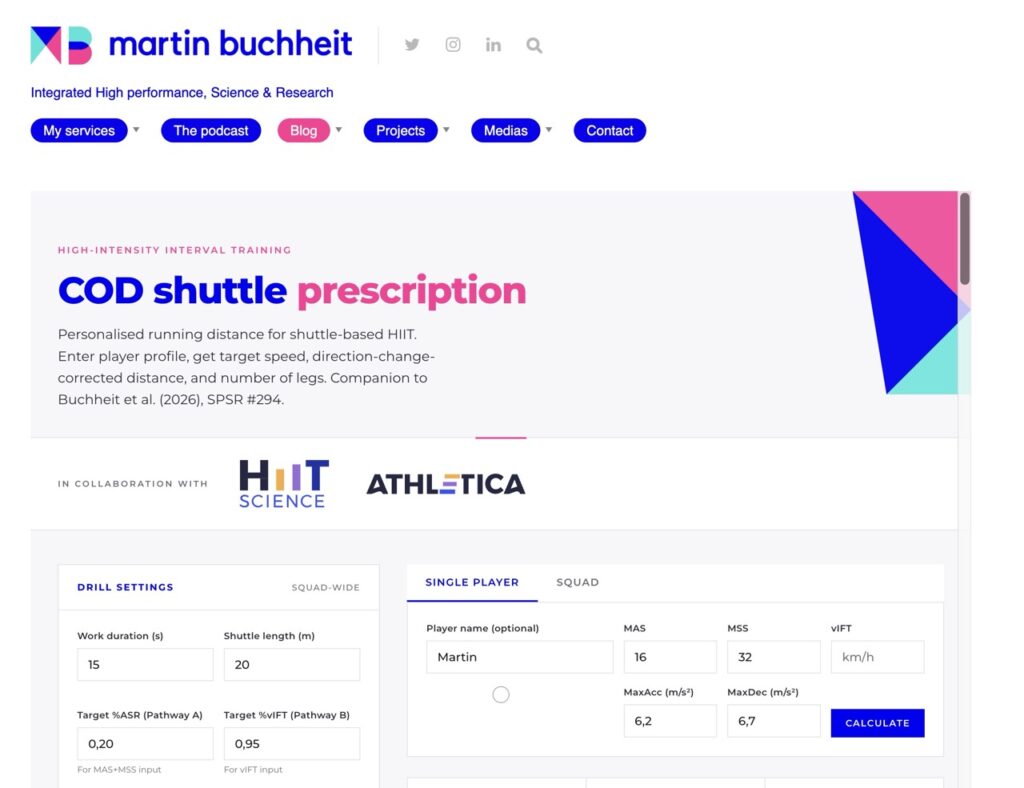
The original stage-distance spreadsheet for the 30-15IFT (based on the 0.7s rule) has served its purpose for two decades, and continues to do so within the test itself. We are NOT changing the test protocol. The 30-15IFT works exactly as designed, and all existing vIFT benchmarks remain valid.
What changes is how we translate vIFT (or MAS/MSS) into training distances. The new spreadsheet uses the mechanistic model and includes a printable squad prescription sheet (25 players) with legs, CODs, last leg distance (colour-coded), and a terminal shuttle rule that automatically removes impractical short final turns
For the vIFT prescription pathway with A0 = 7.5 m/s², the old %vIFT values remain essentially unchanged (0-3pp adjustment). The model’s added value for Pathway B lies in individualizing for players with different A0 and correcting the test-training shuttle length mismatch. For MAS + MSS (ASR) prescription pathway, the model applies directly with no conversion needed.
Download
- Old spreadsheet ENG / Spanish / French (0.7s rule, for reference)
- New spreadsheet (mechanistic model)
- A companion web tool
- More tools from the 30-15IFT webpage