
Modality-Specific Muscle Low-Frequency Fatigue and Recovery Signatures: A Case Report Mapping the HIIT Science Taxonomy
Buchheit M, Laursen PB. Modality-Specific Muscle Low-Frequency Fatigue and Recovery Signatures: A Case Report Mapping the HIIT Science Taxonomy. Sport Performance & Science Reports. 2026; April; 290; v1
Full text here
🦵🏃 You’ve been guessing the neuromuscular cost of your HIIT, SSG and Gym sessions for years. So were we. Here’s the first objective answer.
Which session actually costs more — long repeated sprints or short ones?
Does biking in a sauna destroy your legs or is it basically free?
Are small-sided games more taxing than a Zone 2 run, and by how much?
How long does it actually take to recover between a sprint session and your next hard day?
Every practitioner has asked these questions. Nobody had a direct answer. Because until recently, we simply could not measure the neuromuscular response to training objectively in the field.
Now, about the subject of this study. It’s me. A 47-year-old with more slow-twitch fibers than a sea cucumber, juggling marathon training and recreational padel. Generalize with caution — but the signal is real, and the story behind it took 20 years to tell.
When Paul Laursen and I built the HIIT Science taxonomy nearly two decades ago, we classified training types based on their expected neuromuscular demand. Type 2 more taxing than Type 1. Type 4 more than Type 2 or 3.
That hierarchy was built on reasoning and physiology — not on direct measurement, because we simply didn’t have the tools to measure the neuromuscular response objectively in the field. We were educated guessing. So was everyone else.
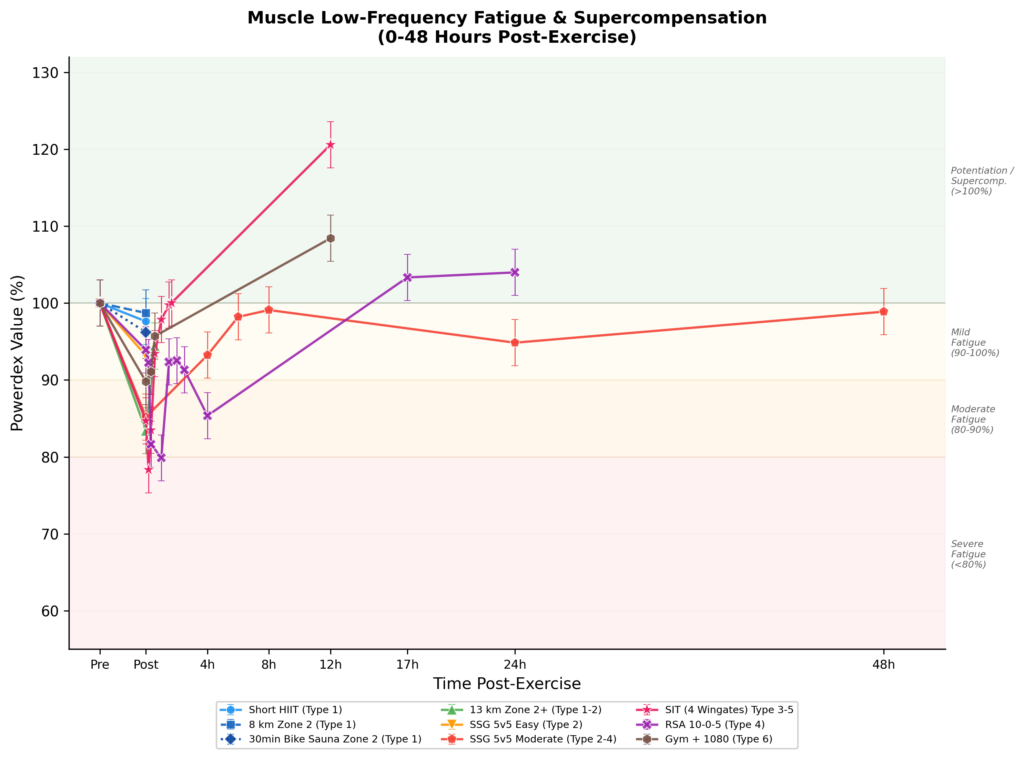
New paper out. We finally have the data. Using the Myocene device (Powerdex), we tracked low-frequency fatigue — a passive, motivation-independent measure of muscle contractility — before, immediately after, and up to 48h post-session across 9 sessions covering the full taxonomy.
The recovery signatures confirmed the hierarchy we had always assumed:
– Type 1 (Zone 2, sauna bike) → Powerdex barely moved. Negligible neuromuscular cost.
– Type 2 (small-sided games, easy) → moderate drop, recovered within 24h.
– Type 4 (RSA with changes of direction) → severe drop below 80%, long-tail recovery beyond 48h.
– Type 3-5 (cycling SIT) → severe acute drop, but rapid rebound within 4h due to concentric-only nature.
The taxonomy’s logic held. Each type leaves a distinct contractile fingerprint. And because we still cannot measure neuromuscular load directly, the second finding matters just as much: Neuromuscular RPE — simply asking athletes how heavy their legs feel — correlated with the Powerdex drop at r = -0.89, well ahead of Global RPE (r = -0.68) and heart rate metrics.
Not perfect, but the best proxy we have. And now we have the numbers to say so.
#SportsScience #LowFrequencyFatigue #HIITScience #NeuromuscularMonitoring #Myocene #Readiness